AI Literacy Program for Schools
Schools need AI literacy plans that are educationally sound, practical for teachers, and realistic for administrators to launch. That usually means starting with a program that can fit enrichment, advisory, computer science, or after-school delivery without forcing a full curriculum rewrite. The best implementation model is the one a school can actually sustain and explain clearly to students, families, and staff.
Start with a scoped pilot, then expand once the implementation model is proven.

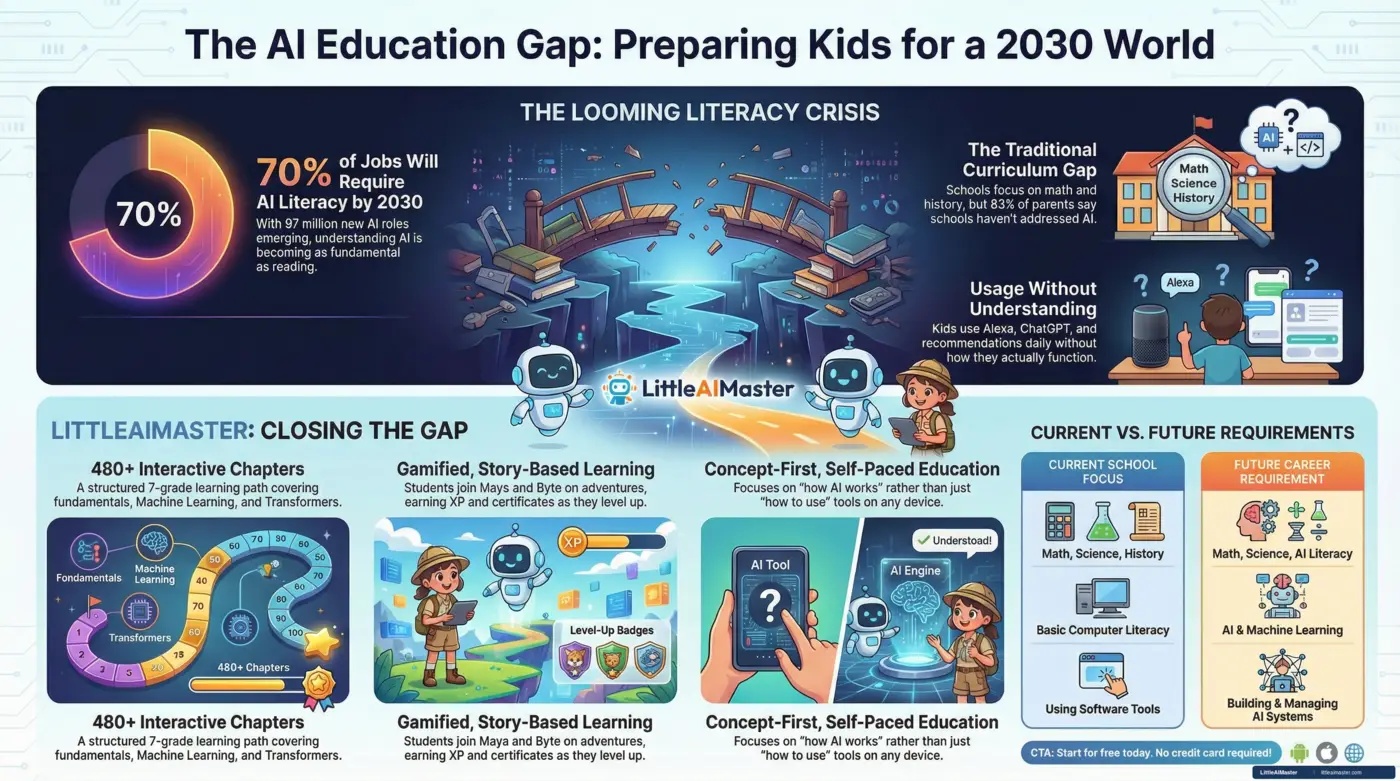
Implementation Models for Schools
Schools do not need a single universal rollout path. They need a model that fits staffing, schedule, and local demand.
Many schools start with enrichment or after-school delivery because it keeps launch risk low. Students who opt in are usually motivated, the implementation footprint is manageable, and the school can gather evidence before expanding. This works especially well when leadership wants to demonstrate demand, understand student readiness, and build confidence before integrating AI literacy more formally.
Other schools prefer to place AI literacy inside an existing subject such as computer science, digital literacy, or advisory. That can work well when the school wants wider reach and clearer year-level expectations. The main requirement is clarity: teachers need to know what is being taught, why it matters, and how the program complements the school’s existing priorities rather than competing with them.
- Pilot with one grade, one section, or one club before scaling sitewide.
- Choose a delivery model that fits current staffing and calendar constraints.
- Use a repeatable onboarding process so expansion is easier after the first term.
Curriculum Alignment Without a Full Rewrite
One of the biggest mistakes in school AI planning is assuming that adoption requires a completely new curriculum map. In practice, a school can start with a complementary program that adds AI literacy where it already makes sense: digital citizenship, computational thinking, project-based learning, research skills, or technology electives. That reduces friction and makes implementation more realistic.
A structured program should help schools move from awareness to progression. Students need more than a one-off assembly or a single chatbot lesson. They need a sequence that covers concepts, examples, limitations, ethics, and applied understanding over time. That is the difference between “students have heard of AI” and “students are becoming AI literate.”
What Teachers and School Leaders Need First
Teachers do not need to become AI specialists before students can begin. They do need a clear program frame, sensible implementation guidance, and confidence that the content is age-appropriate. When a program is self-paced and concept-first, teachers can supervise learning and connect it to classroom goals without needing to build every lesson from scratch.
School leaders need slightly different signals. They need to know how the program will be introduced to parents, how progress can be monitored, how rollout can start small, and how the school will define success. A credible AI literacy program should make those questions easier, not harder.
- Keep expectations simple for the first term.
- Provide parents with clear language about what students are and are not doing.
- Track completion, engagement, and confidence gains rather than only raw usage.
Parent Communication Is Part of the Program
Schools often underestimate how much AI adoption depends on family understanding. Parents want to know whether students are merely learning to use tools or learning how AI actually works. They also want reassurance around privacy, age fit, and academic integrity. A strong school rollout includes parent-facing language early so families understand the educational purpose of the program.
This is why a practical school AI program should connect naturally to a parent education layer. When students learn in school and parents can reinforce good habits at home, adoption becomes steadier. The conversation shifts from uncertainty to shared expectations, which helps teachers and students alike.
Why LittleAIMaster Fits This Rollout
LittleAIMaster is built as a structured path for Grades 6-12, with concept-first coverage that can support enrichment, classroom integration, and school pilots. The platform gives schools a way to introduce AI literacy without asking every teacher to build the sequence from zero. It also creates a coherent story for parents and administrators: students are learning how AI works, where it appears, and how to use it responsibly.
For schools that want to move quickly but carefully, that matters. The right first program is not the most complex one. It is the one that can launch cleanly, show educational value, and grow from a pilot into a durable school capability. If that is your current goal, the next step is usually a scoped demo and rollout conversation rather than another abstract discussion about AI trends.
Authoritative Sources
- AI4K12 initiative (AI4K12)
- ISTE on AI in education (ISTE)