AI Safety Rules for Kids: 7 Household Rules
Children do not need a long list of abstract warnings to use AI safely. They need a few clear household rules they can remember, repeat, and apply when they open a chatbot, upload an image, or rely on an answer for school. Good AI safety is practical: protect personal information, check claims, slow down when something feels off, and ask an adult when the situation becomes sensitive.
Use clear house rules first, then build confidence through guided learning.

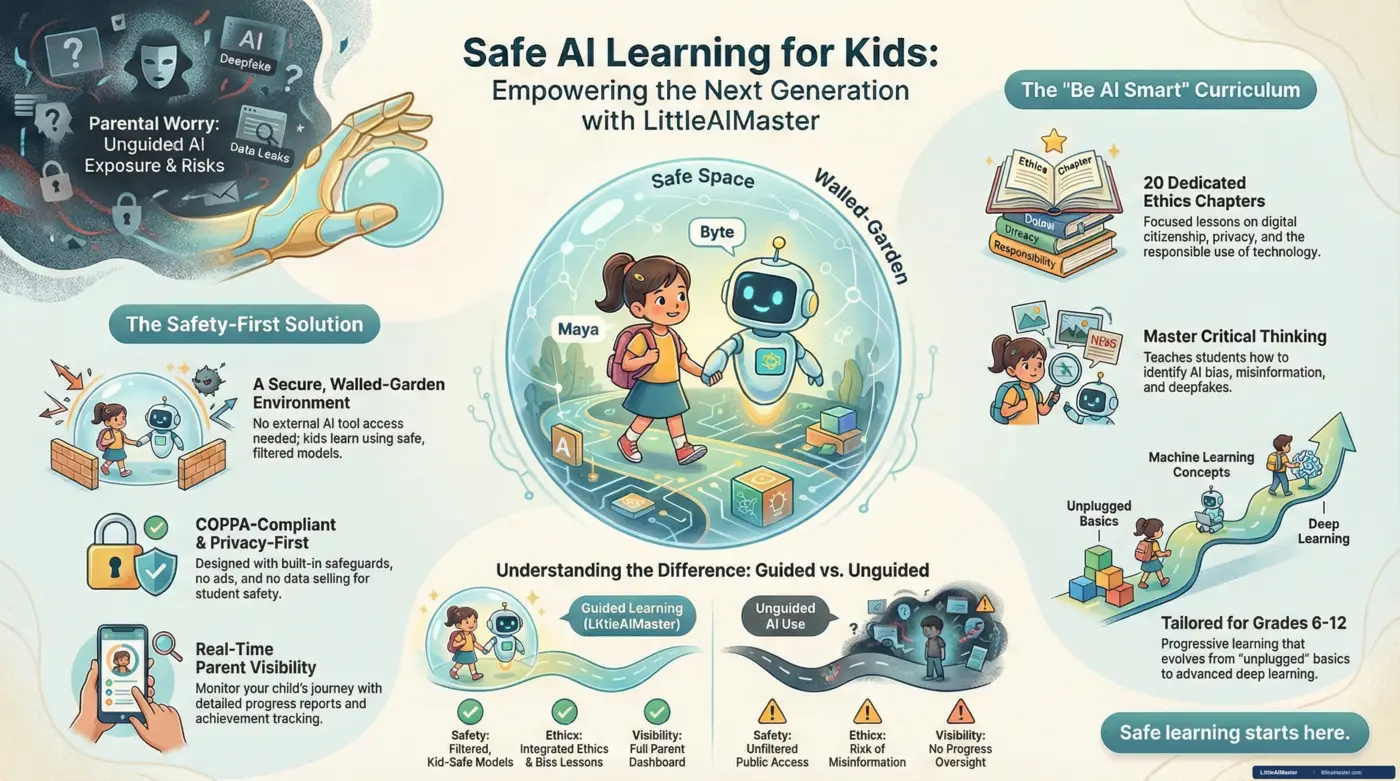
Family Rules That Make AI Safer
A short, repeatable set of rules works better than a broad lecture.
Families should start by writing down a few rules in plain language. Children should know that they do not share full names, addresses, school details, passwords, private photos, or health information with AI tools. They should know that they do not use AI to send messages for them in emotionally sensitive situations. They should also know that school use and casual use are not always the same thing.
The point is not to create fear. It is to create decision speed. When a child has a clear mental checklist, they are less likely to over-share or trust a polished answer too quickly. The safest households are usually the ones where the rules are visible, specific, and reviewed regularly as the child gets older and starts using more advanced tools.
- •Do not share personal or identifying information with AI tools.
- •Do not treat chatbot answers as verified facts.
- •Tell a parent or teacher when an answer feels strange, upsetting, or confusing.
Privacy Starts With the Prompt
Parents often focus on what an AI tool replies with, but the first safety issue is often the prompt itself. Children need to understand that what they type can be stored, reviewed, or used to improve systems depending on the platform and settings. That means a prompt should never read like a diary entry, a medical form, or a private conversation with a friend.
A useful family habit is to rewrite prompts before sending them. Instead of “Here is my full homework and teacher comments,” a child can ask, “Explain how to improve a paragraph that needs stronger evidence.” That small change protects privacy while still getting educational value. It also teaches the child to separate their own thinking from the tool’s suggestions.
Fact-Checking Is a Safety Rule, Not an Optional Skill
Children often notice obvious wrong answers, but the harder safety problem is the answer that sounds credible and still contains errors. Families should treat source-checking as part of using AI, especially for schoolwork, health questions, or anything that affects another person. If an answer matters, it should be checked against a teacher, a textbook, or a trusted source before being reused.
This is also where emotional safety matters. Some AI tools can sound personal, flattering, or overly certain. Children should not use them as substitutes for adults, teachers, or close relationships. When a conversation touches fear, identity, conflict, or self-worth, the right move is to step away from the tool and involve a real person.
When Parents Should Step In Immediately
Parents should step in when a child is using AI around money, health, bullying, unsafe dares, private photos, or emotionally intense conversations. Those are not moments for “let’s see what the chatbot says.” They are moments for direct adult judgment. Children can learn a simple test: if this would be a serious issue in real life, it is also a serious issue in AI.
Stepping in does not need to be punitive. In most cases, it works better as coaching. Ask what the child was trying to do, what the tool suggested, what felt confusing, and what the safer alternative would have been. That keeps the discussion educational rather than purely disciplinary, which makes children more likely to ask for help next time.
Build a Safe AI Routine Instead of One-Time Warnings
The strongest AI safety plan is a routine. Pick which tools are allowed, review them together, set time boundaries, and talk about recent examples from school or online life. If your child is using AI to learn, pair that with structured content such as the ChatGPT for Kids guide or concept-first lessons in the LittleAIMaster app so their understanding grows alongside their access.
Safety gets easier when children feel they are being taught, not merely watched. They should know why a rule exists and what problem it prevents. Over time, that moves them from rule-following to judgment, which is the real long-term goal of AI safety for kids.
- •Choose approved tools instead of allowing every new app by default.
- •Review a few prompts and outputs together each week.
- •Update the rules as school demands and maturity levels change.
Authoritative Sources
- Common Sense Media guidance for families (Common Sense Media)
- NIST AI Risk Management Framework (NIST)