AI Literacy for Children: What Every Parent Must Teach
AI literacy for children does not mean pushing kids into advanced coding early. It means helping them understand what AI is, what it is not, where it appears in daily life, and how to question the outputs they see. Families that start with those basics give children a calmer and more useful foundation than families that treat AI as either magic or a threat.
Start with the free unit, then build from the full grade-by-grade path.

What AI Literacy Means for Families
The goal is not to turn every child into an AI engineer. The goal is to help children become informed users and thoughtful learners.
AI literacy starts with language. Children should know that AI systems are tools built by people, trained on data, and designed to produce predictions, classifications, or generated content. That mental model matters because it keeps kids from treating every answer as a fact. When a child understands that an AI chatbot is predicting a likely response rather than revealing the truth, better habits follow naturally.
For families, AI literacy also includes context. Kids see recommendation systems on video platforms, autocomplete in search, filters in photo apps, and chatbots in school or productivity tools. A parent does not need a technical lecture to explain those moments. It is enough to say: this system is looking for patterns, it can still make mistakes, and we should ask where the answer came from.
- •Explain AI as a pattern-finding tool, not a magic brain.
- •Show children where AI appears in everyday apps they already use.
- •Teach them that fast answers still require human judgment.
What Children Should Understand First
Most children do not need jargon first. They need a sequence that makes sense: data, patterns, outputs, errors, and responsibility. Start with examples such as spam filters, music recommendations, image search, and voice assistants. Then ask a simple question: what signals might the system be using to make that decision? That question introduces the idea that AI depends on inputs and design choices.
The second layer is limitation. Children should learn that AI can sound confident while still being wrong, incomplete, or unfair. That matters for schoolwork, online safety, and emotional trust. If a student asks an AI tool to explain a topic or rewrite a paragraph, they also need to ask whether the answer is current, sourced, and appropriate for the assignment.
- •AI learns from examples and data.
- •AI outputs can be helpful without being correct.
- •People remain responsible for checking, deciding, and using results.
How Parents Can Teach AI Literacy at Home
A strong home approach is conversational and low pressure. Ask children to point out examples of AI they notice during the week, then discuss what the tool is trying to do. If a child uses a chatbot, ask what prompt they used, what answer they got, and how they checked whether it made sense. These small routines build discernment without turning home into another classroom.
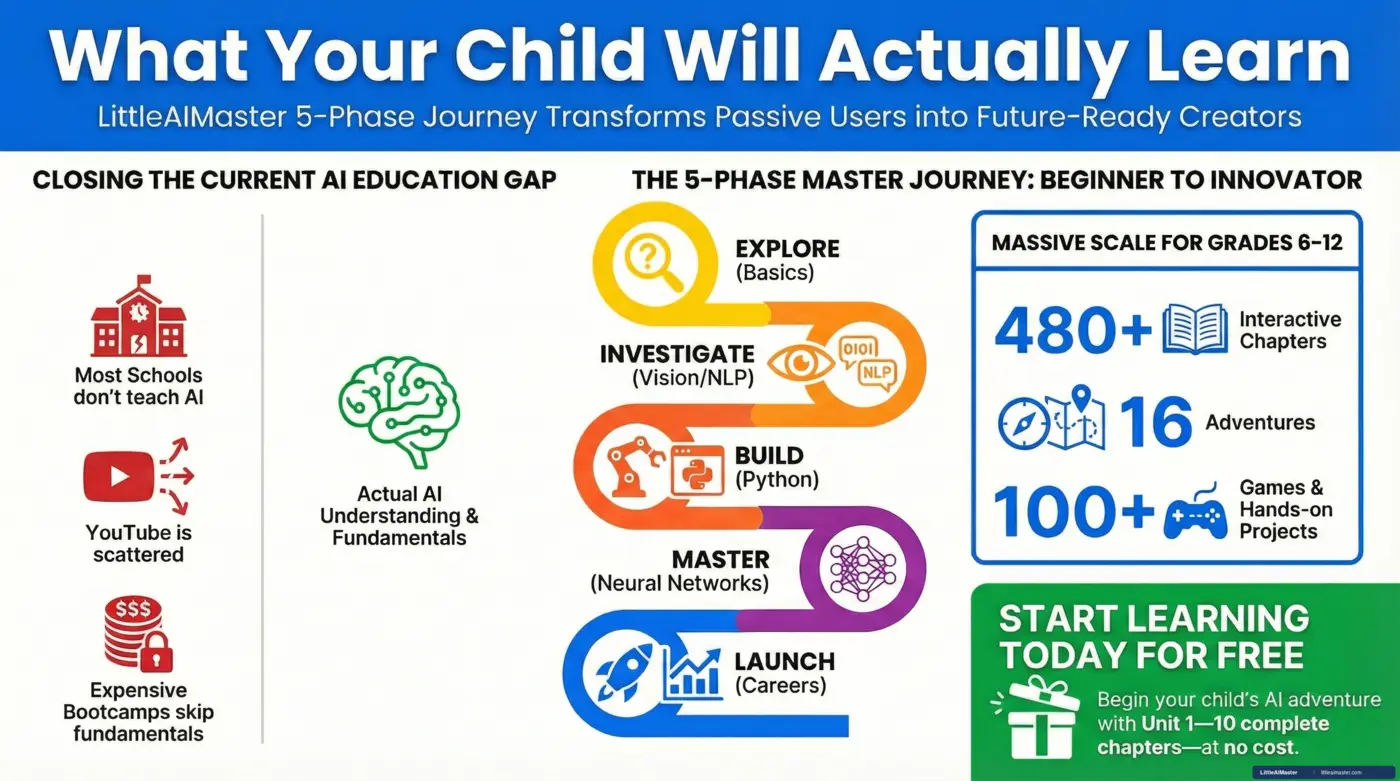
It also helps to connect AI learning to your child’s age and goals. A younger learner may focus on how recommendations, image recognition, and simple prompts work. An older student can start exploring bias, privacy, data collection, and how machine learning models are trained. LittleAIMaster’s Learning Path is built around that progression so families can move from simple explanations to more structured understanding.
- •Use real apps your child already knows instead of abstract examples.
- •Ask them to explain an AI result back to you in their own words.
- •Treat fact-checking as part of using AI, not an optional extra step.
Mistakes That Slow Down Real Understanding
One common mistake is treating AI literacy as only a coding problem. Coding can be valuable, but children need conceptual understanding before they need syntax. If a child can explain how recommendations work, why bias matters, and why prompts affect results, they are already building useful AI literacy even before they write their first line of Python.
Another mistake is making the conversation too dramatic. If AI is discussed only through fear, children either become anxious or tune out. If it is discussed only as opportunity, they miss the importance of privacy, authorship, and accuracy. A better tone is factual and calm: AI is useful, imperfect, and worth understanding because it will shape school, work, and everyday decision-making.
Where LittleAIMaster Fits
LittleAIMaster is designed to support exactly this kind of progression. Students start with concept-first lessons that explain what AI is, how models use patterns, and where AI appears in real life. As they move forward, the content becomes more technical and more applied, but the foundation remains understanding before tool dependence.
That makes the platform useful for families who want more than scattered videos or one-off activities. Parents can point children to a structured route, then use the family conversations above to reinforce it. If you want a child to be confident, careful, and curious around AI, consistency matters more than hype, and consistency is what a guided path provides.
Key Takeaways for Parents
The best time to start AI literacy is when a child is ready to ask questions about the tools they already see. That could happen in late elementary school, middle school, or early high school depending on the child. The important part is not the exact age. It is giving them a framework for understanding data, patterns, mistakes, and responsibility before AI becomes invisible background technology.
- •Start with everyday examples rather than abstract theory.
- •Teach children to question outputs, not just collect them.
- •Build habits of explanation, fact-checking, and disclosure early.